

Kassioun Editorial 1298: Anger Is Escalating, And We Are Before Two Choices!
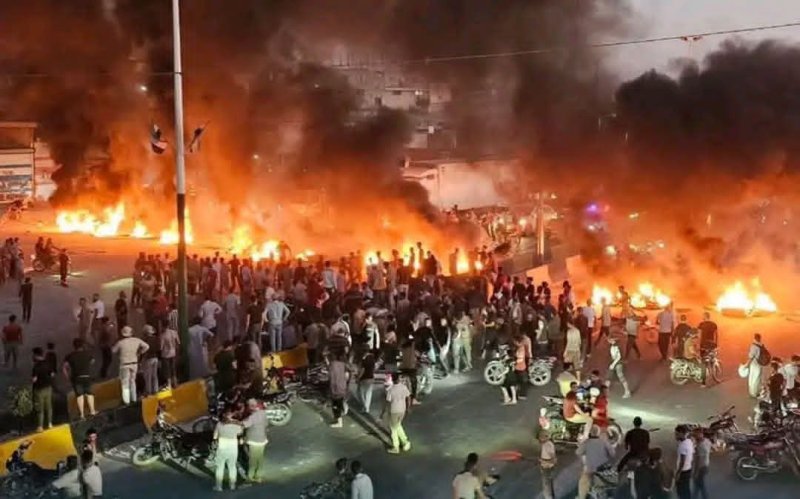
Anyone who underestimates the growing popular anger, day after day, is doing a great disservice to themselves, to the country, and to its people. This anger is a direct result of the deteriorating living and economic conditions—which continue to worsen at an accelerating pace—and of the “shock” economic measures being pursued, which follow the formulas of the IMF and the World Bank in eliminating any social role for the state apparatus and lifting subsidies of various sectors under the pretext of attracting investment and getting rid of “administrative inefficiency” and “corruption”.
The previous Kassioun issue’s editorial, “Thieves… Thieves”, shed some light on the general characteristics and features of the Syrian popular movement in its current phase, including its peaceful nature, learning from past experiences, rationality and higher degree of organization, and continued search for genuine leadership, primarily from within its own ranks.
This movement is continuing to grow, and there is no expectation that it will calm down under any circumstances, as long as the underlying causes driving it remain in place and continue to intensify. However, its growth is not necessarily linear in a positive and upward direction. On the one hand, it is uneven and irregular; on the other, it may develop in a positive direction that serves the country, its unity, the unity of its people, and its sovereignty. However, it can also move in the exact opposite direction if it is not met and addressed properly.
To state things more clearly and directly, anyone seriously following the Syrian situation should not overlook the fact that every further escalation in the popular movement in its peaceful, demands-based form is accompanied by the provocation of crimes and incidents of a sectarian, ethnic, destructive, and security-related nature, in one part of the country or another. This means that there are those who respond to people’s movement to demand their rights by attempting to divide it, sabotage it, and push it in directions that turn it against itself, against its own interests, and against the interests of the country.
At least two parties converge in this kind of destructive response: the thieves and major corrupt figures, whether old or new, who see the killing of Syrians by one another, and Syrians’ hatred of one another—particularly the hatred of the plundered poor toward other plundered poor—as a way out of their predicament and an escape from accountability and from the restoration of rights. This applies whether the issue concerns expropriations, fuel, electricity, wheat prices, public-sector salaries, or any other rights.
The second clear and openly declared party is “Israel”, with its actual infiltrations within all sides and in various locations, seeking to exploit people’s anger by directing it precisely against their own interests and against one another, through sectarian, ethnic, and religious crimes.
Those who assume that the people’s movement will calm down should quickly abandon this illusion. The people’s movement will continue to grow, and those who seek to sabotage it are ready to confront it. So, are the patriots ready for a different kind of engagement—one that can carry the movement and the country safety?
The people’s movement and activism are an asset for the country and an enormous positive force that should be directed along the right path. This requires a higher degree of organization; it requires a positive role by the state institutions toward the movement; and it requires a positive role from the various patriotic Syrian forces in engaging with it—by becoming part of it, learning from it, assisting it, and reinforcing its natural patriotic orientation.
This movement can become the platform from which the country is rebuilt: a united, dignified, and sovereign country whose guiding principles are human dignity and social justice. This is what Syrian patriots should work toward by every possible means, including through a comprehensive general national conference and a national unity government, both of which should serve as instruments in the hands of Syrians to exercise their right to determine their own destiny, for their own benefit—and, specifically, for the benefit of the more than 90% of them living below the poverty line.